



Direct Push vs Hollow Stem Auger (HSA): Which Environmental Drill Rig to Buy?

Anyone buying or replacing an environmental drill rig runs into the same question: direct push or hollow stem auger (HSA)? The answer depends on the soil, the depth, the type of well and the type of project. This guide compares both methods in practical terms so you can pick the right rig before you invest.
How each method works
Direct push
In direct push, rods are driven into the ground by pressure and percussion, without removing material from the borehole. The soil sample comes out continuous, inside a liner (plastic tube), which preserves soil structure and lowers the risk of cross-contamination. It is the typical method for high-resolution environmental investigation, used to locate plumes and decide where to install wells.
Hollow stem auger (HSA)
In HSA drilling, a hollow helical column rotates and advances into the ground. The borehole is held open by the auger itself, and sampling or well installation is done through the inside of the column. It is the classic method for building monitoring wells in unstable soils, such as sands below the water table.
Side-by-side comparison
Criterion | Direct push | Hollow stem auger (HSA) |
Soil sample | Continuous, in a liner | Discrete, using a sampler inside the auger |
Waste generated | Very low | Higher, with cuttings at the surface |
Monitoring wells | Smaller diameters | Larger diameters, with a stabilized borehole |
Unstable or sandy soils below the water table | Needs care | Strong point |
Very dense soils, gravel or hard layers | Limited | More robust |
High-resolution investigation | Strong point | Not its focus |
Five questions to decide
What is the focus of your work? Investigation and plume delineation favor direct push. Building monitoring, extraction and injection wells favors HSA.
What soils do you meet most often? Clays and fine sands suit direct push. Unstable soils below the water table and resistant layers call for HSA.
How deep do you need to go? Check the real depth of each method on the machine's datasheet, not just the catalog figure.
Which standards guide your work? Check the environmental rules in your country and the relevant ASTM guides, such as ASTM D6282 (direct push soil sampling), ASTM D5092 (design and installation of groundwater monitoring wells) and ASTM D5784 (hollow-stem augers in geoenvironmental exploration).
Will you serve more than one type of client? Companies that serve consultancies, fuel stations and industrial sites usually need both methods.
When it makes sense to have both methods on one rig
A rig that does both direct push and HSA saves you from owning two machines, making two mobilizations and training two crews. That matters for companies that switch between investigation and well construction in the same week, and for those who must mobilize quickly on tight sites.
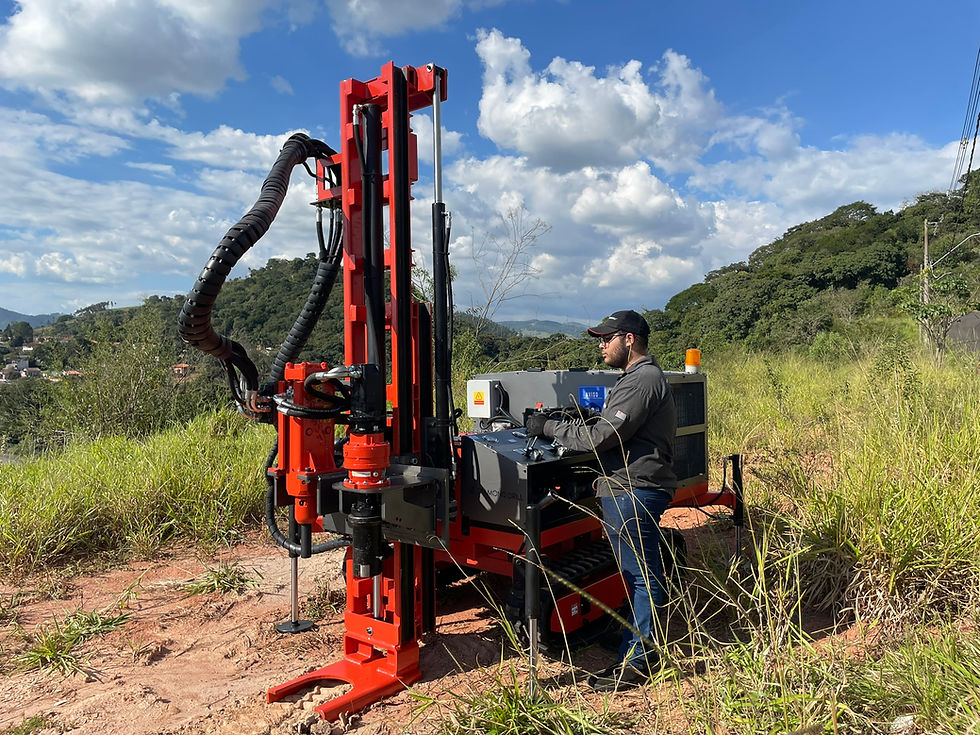
SAM 400: direct push and HSA up to 40 m
The SAM 400, from Diamond Drill, was designed for both applications:
Engine: 89 CV diesel.
Direct push: up to 40 m.
Hollow stem auger (HSA): 7.1/2" x 4", up to 40 m.
Weight: 3,950 kg.
Moving the rig: remote control included.
Tooling kit: sold separately, sized to your operation.
See the full specifications on the SAM 400 page or talk to our technical team to define the right configuration for your type of work.
Summary
Direct push: fast, continuous sampling, low waste, ideal for investigation.
HSA: stable borehole, ideal for building wells and working in difficult soils.
Both on one rig: more flexibility for companies that take on different projects.


Comments